
Understanding world chess ratings is essential for any aspiring player in India. Whether you are a casual fan or a competitive player, keeping track of how the best in the world rank provides a roadmap for your own improvement. On Qureka, we dive deep into the numbers that define the kings and queens of the 64 squares.
Why World Chess Ratings Matter
The Elo rating system is the heartbeat of professional chess. It isn’t just a number; it represents a player’s relative skill level. When you look at world chess ratings, you are looking at years of discipline, tactical brilliance, and mental stamina. Qureka aims to make these complex statistics easy for everyone to grasp.
For players in India, following chess ratings is more exciting than ever. With the rise of young talents like Gukesh D and Praggnanandhaa, the global leaderboard frequently features Indian names. Qureka provides the context you need to understand how these rankings shift after every major tournament.
The Mechanics of the Rating System
How does a player gain or lose points? It depends on the strength of the opponent. If a high-rated player beats a lower-rated one, their chess ratings change only slightly. However, an upset can cause a massive swing. Qureka tracks these fluctuations to show you who is truly in top form.
Different Formats, Different Ratings
It is important to remember that world chess ratings are split into three main categories:
- Classical: The traditional, long-form games.
- Rapid: Faster games where clocks are set for 15 to 60 minutes.
- Blitz: Lightning-fast chess where every second counts.
Qureka highlights that a player might be a genius in Blitz but struggle in Classical. Monitoring world chess ratings across all formats gives a complete picture of a player’s versatility.
India’s Rise in World Chess Ratings
India has become a global powerhouse in chess. Currently, the world chess ratings show a significant density of Indian players in the top 100. This is a testament to the robust chess culture in the country. Qureka celebrates this growth by providing detailed breakdowns of local heroes.
“The surge of Indian talent in the chess ratings is not an accident; it is the result of a dedicated ecosystem of coaches and tournaments.” — Qureka Analysis.
When you analyze world chess ratings, you see that the gap between the legendary Viswanathan Anand and the new generation is closing. Qureka believes this healthy competition is what keeps the sport thriving in India.
How to Use World Chess Ratings to Improve
You don’t have to be a Grandmaster to care about world chess ratings. You can use the games of top-rated players as a study guide. By watching how players with high chess ratings handle the opening or the endgame, you can sharpen your own skills. Qureka suggests picking a favorite player from the top list and studying their style.
Key Factors Influencing Rankings:
- Consistency: Staying at the top requires avoiding losing streaks.
- Tournament Selection: Playing against the right level of competition.
- K-Factor: A mathematical coefficient that determines how much a rating changes.
Qureka notes that understanding the K-factor is vital for young Indian players looking to climb the world chess ratings ladder quickly.
See also: Indian Chess Players: Master Your Strategy with Qureka
Top Players to Watch Right Now
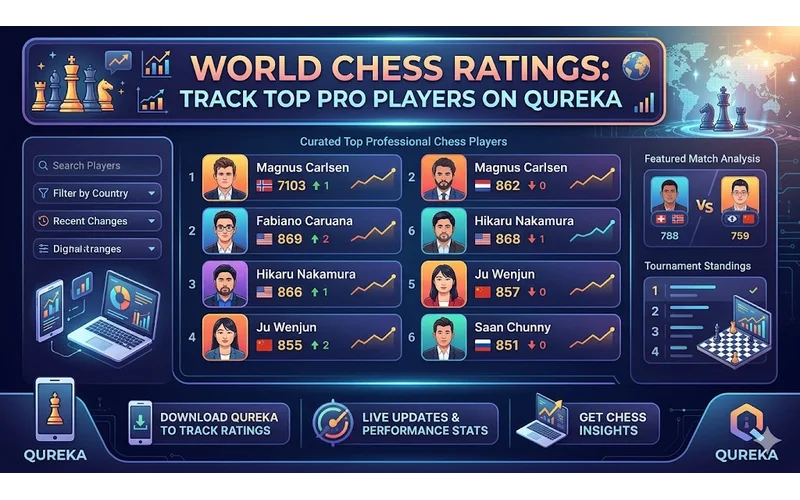
While Magnus Carlsen has dominated the chess ratings for years, the chasing pack is more diverse than ever. On Qureka, we keep a close eye on the “2700 Club”—players who have crossed the elite 2700 rating threshold.
- Magnus Carlsen: The perennial leader of world chess ratings.
- Fabiano Caruana: Known for his deep opening preparation.
- Hikaru Nakamura: A dominant force in speed chess.
Qureka tracks these players not just for their scores, but for the innovative ideas they bring to the board. Following world chess ratings allows you to see the evolution of chess theory in real-time.
The Role of FIDE
The International Chess Federation (FIDE) is the official body that manages world chess ratings. Every month, they release updated lists. Qureka ensures you stay updated with these monthly releases so you never miss a change in the hierarchy.
The integrity of world chess ratings is maintained through strict anti-cheating measures and verified tournament results. Qureka respects this tradition of fairness, which makes the climb to the top so prestigious.
Common Myths About Ratings
Many beginners believe that world chess ratings are a permanent measure of intelligence. This is a mistake. Qureka wants to clarify that ratings measure performance, not potential. A dip in someone’s world chess ratings could simply mean they are going through a rough patch or testing new strategies.
Another myth is that you must play every day to maintain your rank. In reality, world chess ratings only change when you play rated games. Qureka encourages players to focus on quality over quantity to protect their hard-earned points.
Qureka’s Guide to Your First Rating
If you are in India and want to enter the world chess ratings system, you must start with local FIDE-rated tournaments. Qureka recommends joining a local club recognized by the All India Chess Federation (AICF).
Once you get your first official number, you are officially part of the global community. Even if your score is far from the top world chess ratings, the journey of improvement is what matters most. Qureka is here to support that journey with resources and updates.
Technical Performance and Rankings
Modern chess is heavily influenced by AI and engines. Players with the highest world chess ratings often use powerful software to find “the truth” in a position. Qureka explains that while engines help, the human element of psychological pressure still decides most games.
The struggle to maintain high world chess ratings involves managing stress as much as finding the best moves. Qureka observes that the best players are often those with the best physical and mental fitness.
Future Trends in World Chess Ratings
What does the future hold? We are seeing younger and younger players enter the world chess ratings top tier. The age of Grandmasters is dropping, and Qureka predicts that the next world champion could be a teenager from India.
As more tournaments move online, FIDE is looking at ways to integrate online performance into official world chess ratings. Qureka will be the first to let you know how these changes will affect your favorite players.
Conclusion
Tracking world chess ratings is a window into the highest level of human competition. For the Indian audience, it is a source of national pride and a tool for self-improvement. Qureka remains dedicated to bringing you the most accurate and easy-to-read chess content.
Stay tuned to Qureka for more insights into the world of strategy, skill, and grandmasters. Whether you are aiming for the top of the world chess ratings or just want to win your next casual game, we are your partner in chess excellence. Register now to get started today!

